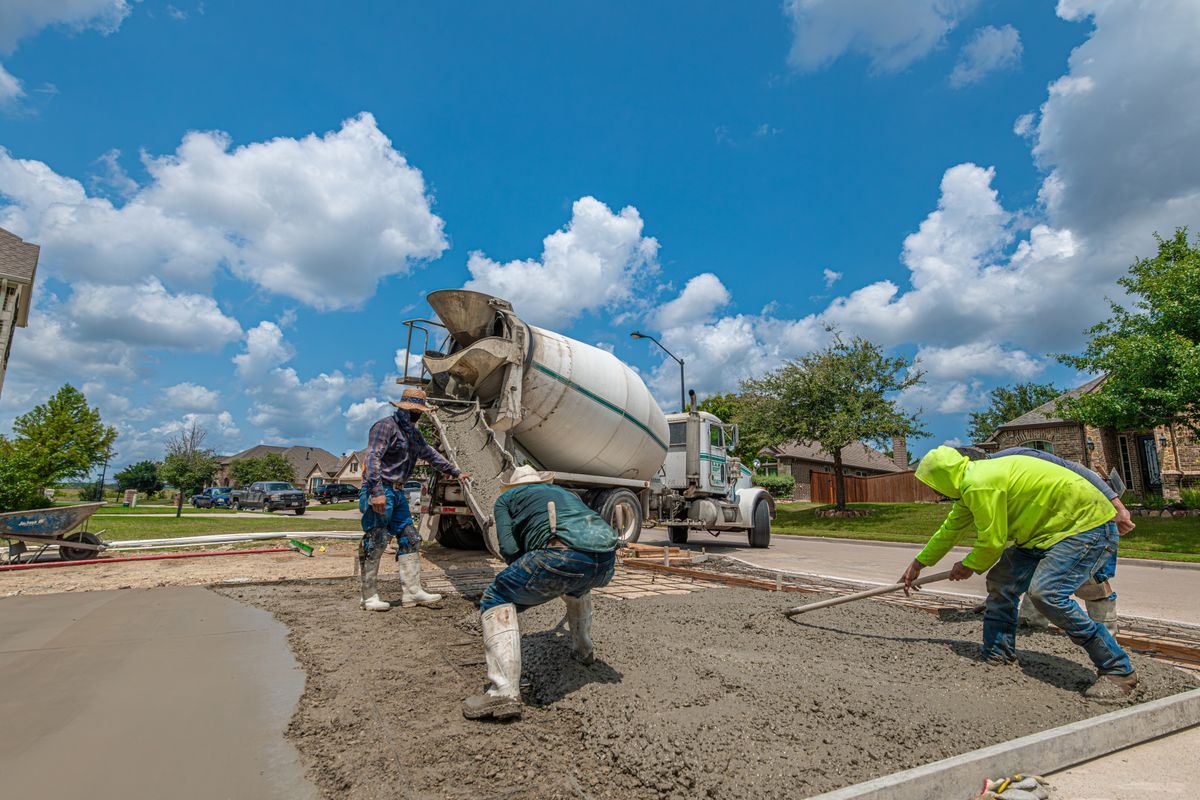
Concrete looks harmless — it’s just wet gray mud, right up until it isn’t. The hazards on a pour don’t announce themselves the way a table saw does. They’re slow burns, invisible dust, and the one bag you lift wrong. After 18 years of pours across Montgomery County, here’s the safety talk we give every new crew member — and every homeowner who tells us they’re going to “just do it themselves.”
Whether you’re a contractor running a three-man finishing crew or a Potomac homeowner setting fence posts on a Saturday, the same four things put people in urgent care: caustic wet concrete, respirable silica dust, lifting injuries, and the weather. None of them are exotic. All of them are preventable. Let’s go through them the way we’d walk a job.
01 / Chemical burnsWet concrete is caustic — and it works slowly.
This is the one DIYers never see coming. Fresh concrete is highly alkaline — a pH of roughly 12 to 13, close to oven cleaner. Kneel in it, let it slop into a boot, or wear soaked gloves for an afternoon, and it will pull the moisture out of your skin and cause a serious alkaline burn. The cruel part: it doesn’t hurt much at first. People finish the job, drive home, and wake up with second- or third-degree burns on their knees and shins that need a skin graft.
- Wear waterproof gloves and boots — not cotton, which soaks and holds the slurry against your skin.
- Use waterproof kneepads whenever you’re finishing at grade. Rubber boots tucked under, never open at the top.
- Keep clean water on site and rinse any splash immediately — don’t wait for it to sting.
- If concrete gets inside a glove or boot, stop and take it off. A pour is not worth a graft.
- Eye splash is a medical emergency — flush for 15 minutes and go to urgent care.
Every stamped and decorative pour we do — the kind on our stamped concrete patios page — involves crew members kneeling in wet mix for hours to detail joints and release color. Waterproof knee protection isn’t optional on those jobs. If you’re a homeowner attempting a small slab, treat your skin the same way a pro does.
Concrete doesn’t burn you like fire. It burns you like patience. — A finisher who learned the hard way.
02 / Silica dustThe hazard you can’t see until it’s in your lungs.
Cutting control joints, grinding a slab, chipping out old flatwork, or mixing dry bags all throw respirable crystalline silica into the air. Breathe enough of it over enough years and it scars your lungs — silicosis, which is irreversible and, in Maryland, entirely preventable with the right controls. This is where weekend DIYers get careless, because a dust mask from the paint aisle does nothing.
- Wet-cut everything. A saw with water suppression at the blade eliminates the vast majority of airborne silica.
- If you must dry-cut, use a vacuum-shrouded blade rated for it — not a broom afterward.
- Wear a proper N95 or half-mask respirator, fit to your face. Not a bandana, not a surgical mask.
- Mix bagged concrete outdoors and downwind, and pour the bag low and slow into the mixer.
Under federal OSHA’s respirable-silica standard — enforced in this state by Maryland Occupational Safety and Health (MOSH), our state-run OSHA program — contractors are required to have a written exposure-control plan for silica-generating tasks. That’s not red tape; it’s the difference between a crew that retires healthy and one that doesn’t.
03 / The physical tollBacks, hands, and the 80-pound bag.
The injury that ends the most concrete careers isn’t dramatic. It’s a lower back that finally gives out. A bag of concrete mix weighs 60 to 80 pounds, a wheelbarrow of wet mud far more, and a finishing crew moves thousands of pounds in a day — often bent over, often twisting.
- Lift with your legs, pivot with your feet. Never twist a loaded spine. It sounds like a poster because it’s true.
- Split the load. Two people on a heavy form, a cart for bags, a chute or pump instead of hand-hauling mud across a yard.
- Mind your hands. Rebar ends, form stakes, and trowel edges. Cut-resistant gloves and capped rebar save fingers and shins.
- Hydrate and rotate. Fatigue is how the last pour of the day becomes the injury of the week.
Homeowners underestimate this most. A paver driveway or a flagstone patio looks like a manageable weekend — until you’ve moved two tons of base stone and pavers by hand and your back locks up on Sunday night. If a project involves that kind of tonnage, it may be the moment to hand it to a crew that lifts for a living.
MOSH, workers’ comp, and why Maryland is different.
Maryland runs its own workplace-safety agency — MOSH — which inspects jobsites and enforces the same core standards as federal OSHA, sometimes more strictly. Nearly every Maryland employer with employees is required to carry workers’ compensation insurance, and a genuinely injured worker is generally entitled to medical coverage and wage benefits regardless of who was at fault.
One quirk worth knowing: Maryland is one of only a handful of states that still follows contributory negligence in injury cases. Outside the workers’-comp system, if you’re found even slightly responsible for your own injury, it can bar a claim entirely. That’s exactly why documentation, PPE, and knowing your rights matter so much here.
04 / DIY-specific hazardsThe weekend-warrior blind spots.
Contractors have habits that keep them safe. DIYers have enthusiasm, which is not the same thing. The most common ways homeowners get hurt on a concrete project:
- Rented equipment they’ve never used. Plate compactors, mixers, and cut-off saws kick, grab, and bind. Read the rental yard’s instructions before you start, not after it jumps.
- Formwork blowouts. Under-staked forms can burst under the pressure of wet concrete and knock someone down. Overbuild your forms.
- Overhead and buried utilities. Call Miss Utility (811) before you dig — it’s free, it’s the law in Maryland, and it keeps you off the wrong end of a gas or power line.
- Working alone. No spotter, no one to call for help. Don’t pour a slab solo.
There’s no shame in scoping a project honestly. Some jobs — a small sidewalk, setting a mailbox post — are perfectly reasonable DIY. Others, like a load-bearing concrete driveway or a full outdoor kitchen with gas and drainage, involve enough weight, equipment, and code exposure that a licensed crew is the safer and often cheaper answer once you price in a hospital visit.
05 / When someone gets hurtWhat to do — and who to call.
Even careful crews and careful homeowners have bad days. If someone is injured on a concrete job, the order of operations matters:
- Treat it, don’t tough it out. Alkaline burns and eye splashes get worse with time — get to urgent care early.
- Document everything. Photos of the scene, the equipment, the conditions; names of anyone present; the date and time.
- Report it. For a worker, notify the employer in writing so a workers’-comp claim is on record. Serious incidents may be reportable to MOSH.
- Understand your options before you sign anything. Insurance adjusters move fast; you don’t have to.
That last point is where people get shortchanged. A concrete finisher whose back gives out because a general contractor skipped the fall-protection plan, or a homeowner whose rented mixer was handed over with a defective guard and mangled a hand, is often owed far more than the first check offered — and in a contributory-negligence state like Maryland, the details decide the case. When an injury was caused by someone else’s negligence — a careless site operator, an unsafe rental, a defective piece of equipment — it’s worth talking to a Maryland personal injury attorney who handles construction and jobsite cases before you accept a settlement. A short consultation costs nothing and can be the difference between covering your medical bills and eating them.
We’re contractors, not lawyers.
Nothing here is legal or medical advice — it’s jobsite experience. For a burn or a broken bone, see a doctor. For a serious injury someone else caused, see a lawyer. Our job is to make sure the pour goes right in the first place so you never need either.
06 / The weatherHeat, cold, and the Maryland calendar.
Weather is a safety issue, not just a quality one. A 95° July afternoon in Bethesda flash-sets concrete and cooks the crew; heat illness is real and it moves quickly. A January cold snap makes surfaces icy, gloves stiff, and fresh concrete slow to gain strength — and a slab you can’t walk on safely is a fall hazard for days.
- Summer: start early, shade the water and the crew, take real breaks, and watch for heat exhaustion — dizziness, cramps, stopping sweating.
- Winter: mind ice underfoot, keep the pour protected, and never rush foot traffic onto a slab that hasn’t cured.
We plan pours around this on purpose — there’s a reason spring and fall book out first. If you’re timing a project, our guide to the best time of year to pour concrete in the DMV covers the seasonal windows in detail, and it’s as much a safety read as a scheduling one.
07 / Final wordThe safest crew is the boring one.
Good concrete work is unremarkable to watch. Nobody rushing, nobody bleeding, nobody in a t-shirt cutting a dry slab in a cloud of dust. Gloves on, respirators fit, forms overbuilt, water on hand, and someone always watching the person doing the risky part. That’s not caution for its own sake — it’s what lets a crew do this for 30 years and walk away with two good lungs and a straight back.
If you’re weighing whether a concrete or hardscape project in Potomac, Bethesda, Rockville or anywhere in Montgomery County is a safe DIY or a job for a licensed crew, we’re happy to give you an honest read — even if the honest answer is “you’ve got this.” Request a free estimate or call us at (240) 424-0124.
This article is general jobsite-safety information from a concrete contractor, not legal or medical advice. For an injury, consult a medical professional; for questions about a specific injury claim, consult a licensed Maryland attorney.