Stamped concrete patio cost in Maryland — a 2026 price breakdown.
Per-square-foot pricing for Potomac, Bethesda and Rockville — base, stamping, sealing, the costs quotes hide, and how it compares to pavers.
Stamped concrete patios built like driveways — reinforced 4″ slab over 4–6″ of compacted CR-6, integral color, ashlar slate / herringbone brick / European fan patterns, antiquing release washed clean before high-solids sealer. Engineered for Montgomery County clay, freeze-thaw and the south-facing summers that bake a Bethesda backyard.
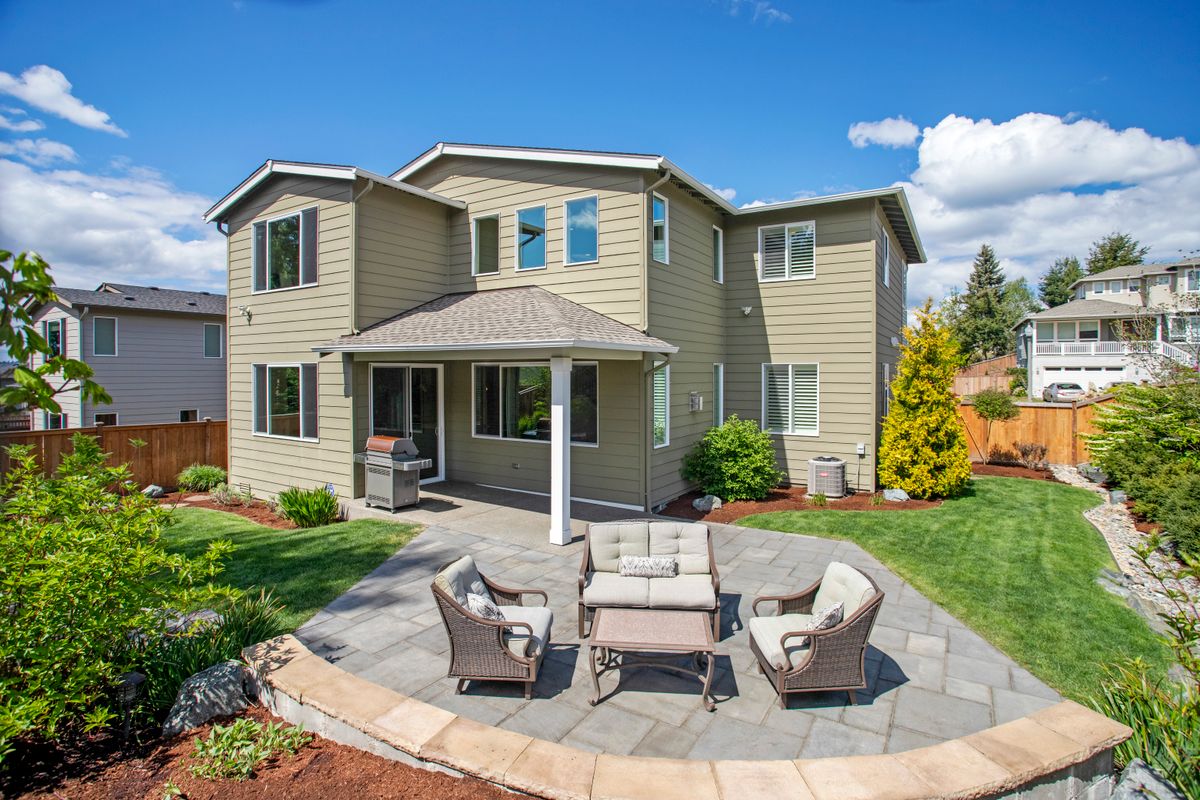
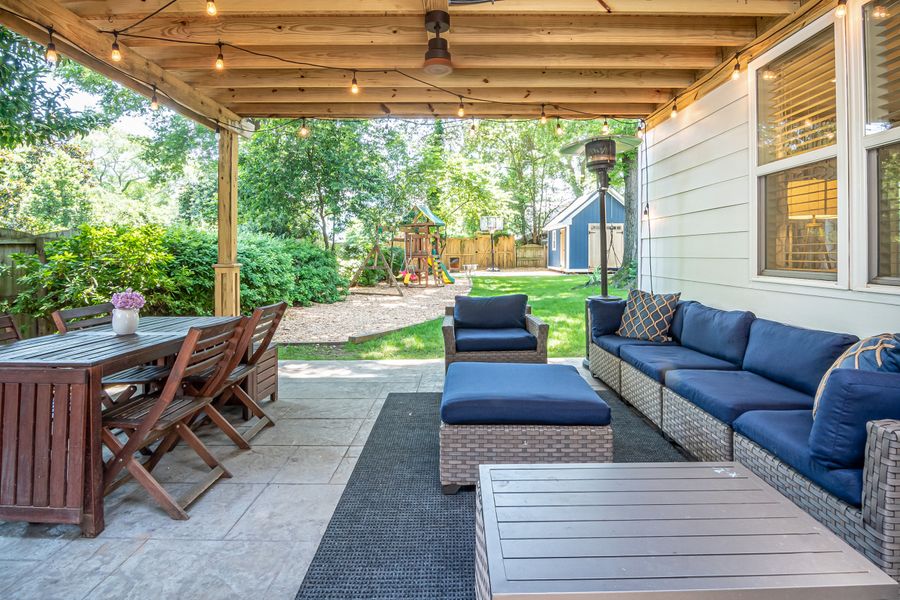
A stamped patio is asked to do two things that fight each other — look hand-laid forever, and survive a Maryland winter on plastic-mat impressions only 3/8″ deep. In Texas you can almost set it and forget it. In Montgomery County, the slab freezes hard from late December, sees 60 inches of rain a year, and gets pressure-washed every spring — all of which beats up sealer faster than anywhere else we work. Everything we spec is built around that climate.
What it changes job to job in our service area:
The honest 2026 number for a properly built stamped concrete patio in our service area is $14 to $28 per square foot, with most projects landing $17 — $22. Below is the same line-item sheet that lands in your inbox after the site walk — nothing rolled into “misc.”
A two-color antiqued ashlar slate with a hand-tooled brick border lands closer to $10,000 — $11,500 at 400 sq ft. For the same patio at 600 sq ft, plan on $9,600 — $13,800 single-color and up to $16,800 with the border. For the deeper line-item walk-through on concrete work in general, the journal post The honest cost of a concrete driveway in Maryland — 2026 breakdown tracks how these numbers move with sub-base and reinforcement choices.
Typical 350–500 sq ft backyard patios in King Farm, Hungerford and Twinbrook — single-color ashlar slate most-installed.
Larger 600–1,000 sq ft entertainment patios with seat walls and integrated fire features — multi-color stamped with custom borders.
400–700 sq ft walk-out and rear-yard patios, frequent step-down detailing to grade and herringbone brick patterns to match older trim.
Same logic as a driveway, slightly forgiving thickness because a patio doesn’t see 4,000-lb point loads. We still lay it in two lifts, plate-compacted, and roll the clay sub-grade first so the gravel locks in. In low-lying Bethesda yards, geotextile fabric goes in between clay and gravel.
Stamped patios that crack across the field almost always have fiber-mesh-only reinforcement and a 3″ or non-existent base. Half-inch (#4) or 3/8″ (#3) rebar tied on 18″ centers and chaired off the sub-base keeps the slab acting as a single piece through freeze-thaw.
Same residential Maryland standard as a driveway. The 5–7% entrained air gives the slab somewhere to expand into when water inside it freezes — without it, the stamped surface spalls and loses pattern detail within two winters.
Every stamped patio gets saw-cut joints within 12 hours of finishing, placed deliberately along grout lines in the pattern so they read as part of the design instead of a scar across the field. 8′–10′ spacing is the rule.
We seal day 14 once the slab has fully cured, with a high-solids (25%+) acrylic or a hybrid urethane for higher-traffic patios near pools. Anti-slip silica or polymer aggregate is mixed into the second coat where appropriate. The reseal schedule is on the hand-off sheet.
Walk-out basement patios in Bethesda almost universally sit below the surrounding grade with poor positive drainage. Before forms go in, we trench a 4″ perforated French drain along the foundation wall and slope the patio 1.5% away from the house. A patio that ponds at the foundation is a basement-water-intrusion call in two winters.
Our most-installed pattern and for good reason — it reads as natural stone, hides the inevitable saw-cut joint along grout lines, and works under both formal Potomac architecture and modern Bethesda infill. Two-tone antiquing in slate-gray over a buff base is the most-requested combination.
The right call when the architecture leans traditional — older Bethesda colonials, Chevy Chase Tudors, Rockville foursquares. Reads as a brick paver patio without the joint maintenance. Holds up well against red-brick or limestone trim.
For larger Potomac entertainment patios where the pattern needs to anchor visually. Smaller-scale cobble repeats also work as borders against an ashlar slate field.
A growing request for modern, single-story rear additions — rectangular plank impressions stained in two browns to mimic boardwalk decking. Lower-relief patterns hold a sealer better than deep cobble.
Stamped concrete wins on cost-per-square-foot, joint-free maintenance (no weeds, no ants), and the freedom to pour any shape you can form. Flagstone wins on natural variation, repairability (lift a stone, reset it), and a thermal mass that runs cooler underfoot in August. We’ll walk you through the trade — sometimes the honest answer is flagstone, especially for shaded north-facing yards where sealer chalks faster.
Pennsylvania bluestone, Tennessee Crab Orchard and Arizona sandstone over a 4″ CR-6 base — 2026 pricing, dry-laid vs. mortar-set, and what Maryland freeze-thaw asks of stone.
$14 — $28 per square foot installed, with most projects landing $17 — $22. A 400 sq ft single-color stamped patio runs $6,400 — $9,200; multi-color with custom borders pushes toward $11,000+. Every Kempf Mill proposal itemizes the slab, color, stamping and sealer separately so you can see exactly where the dollars go.
Every concrete slab moves. The question is where. Saw-cut control joints placed within 12 hours of finishing — hidden along the pattern’s grout lines — route shrinkage cracks under joints so they stay invisible. Random cracking across the field always traces to a thin sub-base or skipped joints.
Every 3 to 5 years in our climate. Maryland UV, freeze-thaw and pool chemicals break sealers down faster than indoor exposure. We use 25%+ high-solids acrylic or hybrid urethane sealers and email a reminder when you’re due.
Yes — pool-deck stamped concrete is one of our most-requested Potomac jobs. The spec changes slightly: hybrid urethane sealer (chlorine-resistant), broadcast anti-slip aggregate in the second coat, and a slip-coefficient-tested release powder. Plan $18 — $26 / sq ft for pool-deck-grade work.
Integral color hardeners are UV-stable and don’t fade. What changes over time is the sealer — it chalks and dulls the color depth. Each reseal restores the wet-look the way it was on day one.
Yes — risers and seat-wall faces get mat-stamped to match the field, so the patio reads as a single carved piece instead of a slab with afterthought stairs. Common request on Potomac entertaining patios.
Foot traffic is fine 24 hours after the pour. We wait 14 days to seal so the slab is fully cured. Heavy furniture and grills can move on after the sealer cures — about day 16.
For sub-base, reinforcement and finish breakdowns that drive both stamped-patio and driveway pricing, the Journal post is the deeper read. Read the breakdown →
Per-square-foot pricing, a realistic resealing schedule and an honest comparison with pavers and flagstone for Maryland backyards.
Per-square-foot pricing for Potomac, Bethesda and Rockville — base, stamping, sealing, the costs quotes hide, and how it compares to pavers.
A 2026 head-to-head on the three patio surfaces we build most in Montgomery County — cost, freeze-thaw durability, drainage, and resale.
Salt, UV, and freeze-thaw — a realistic resealing schedule for Bethesda and Rockville patios that actually keeps color.
Site walks across Rockville, Potomac and Bethesda are no-charge and no-pressure. Pattern and color samples on site, line-item proposal in your inbox inside 72 hours.
Request a stamped patio estimate